How to Leverage AI in Marketing: Smarter, Faster Growth
The marketing landscape is undergoing rapid transformation, making it challenging for teams to keep pace. Modern users expect immediate answers, navigate multiple channels before engaging with a website, and rely on search results that often summarize key information, including AI Overviews and other Large Language Models (LLMs) that provide structured answers previously requiring extensive research. In this environment, the strategic integration of Artificial Intelligence (AI) into marketing practices is no longer optional but a necessity for businesses to remain competitive.
Key Takeaways
AI offers numerous advantages for marketing teams, including the acceleration of tedious tasks, provision of superior insights, and enhancement of overall results. Its utility extends to content planning and creation, gathering competitive intelligence, improving customer service, and more. A variety of AI tools are available to automate processes and streamline marketing strategies.
Benefits of Using AI in Marketing
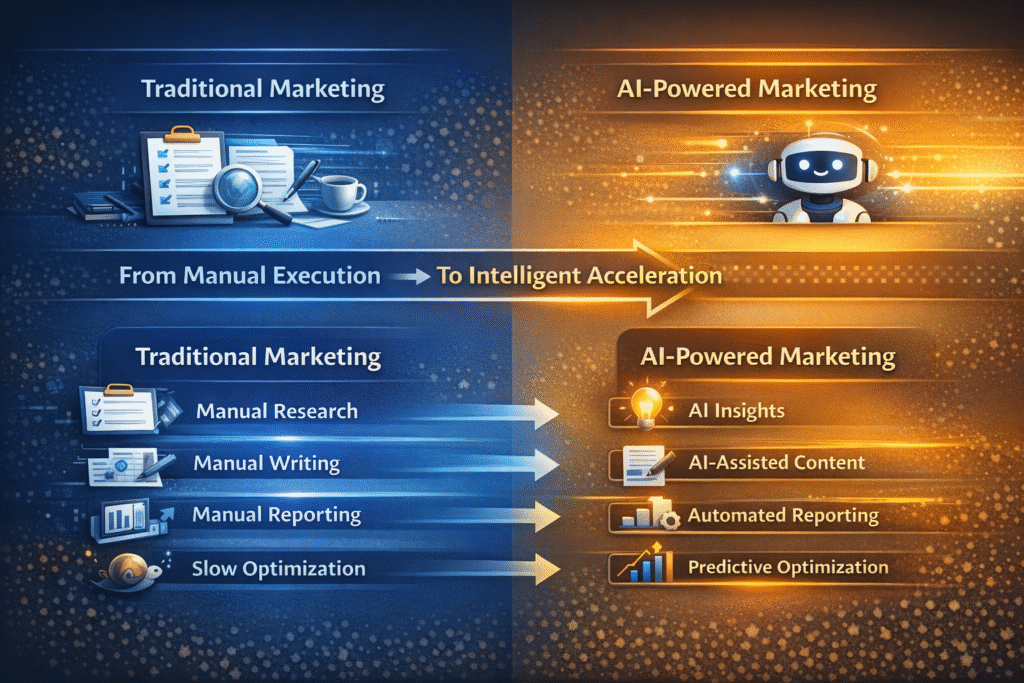
Incorporating AI into a marketing strategy, when utilized correctly, yields several significant benefits:
- Speed Up Processes: AI empowers marketers to expedite processes and reduce the time spent on manual tasks. A HubSpot’s State of AI Report indicates that 79% of marketers agree that AI helps them minimize manual work, highlighting its value.
- Improve Personalization: AI’s capacity for analyzing vast amounts of customer data allows for deeper insights into audience preferences, facilitating more effective content personalization and audience segmentation. This enhanced personalization directly contributes to improved campaign results.
- Better Insights: AI’s superior data analysis capabilities enable earlier identification of trends, more efficient forecasting of sales and customer behavior, and ultimately, better decision-making for marketing teams.
- Cost Savings: By streamlining operations and automating specific tasks, AI tools reduce the need for extensive human resources in certain areas, leading to cost savings within the marketing budget. While AI should not replace core human roles, it frees up personnel to focus on high-impact strategic initiatives.
- Higher ROI: The combined benefits of enhanced customer understanding, personalized campaigns, and improved content quality, all facilitated by AI, result in a higher return on investment (ROI) for marketing efforts.
How AI Works With Marketing: 9 Use Cases
AI presents a diverse range of applications within marketing:
- Content Planning: AI chatbots are powerful tools for brainstorming content ideas. By providing business context and content goals, chatbots can suggest novel topics, which can then be refined using SEO tools to identify relevant keywords.
- Content Creation: While AI should not manage the entire content creation process, it can provide significant assistance. This includes developing comprehensive outlines, generating introduction ideas, or drafting initial summaries for expansion by human writers.
- Marketing Automation: AI tools can be integrated into existing marketing automation workflows to boost team productivity. They can serve as steps within workflows or assist in setting up entirely new automated sequences, thereby improving efficiency.
- Customer Service: AI-powered chatbots on websites can handle basic customer inquiries, escalating more complex issues to human representatives. This ensures that human customer service teams can focus on major concerns while AI addresses smaller queries.
- Audience Segmentation: AI tools excel at analyzing large datasets of customer information, enabling more effective audience segmentation than manual analysis. This leads to the creation of more personalized campaigns and marketing initiatives.
- Social Listening: Integrating AI into social listening strategies allows for quicker data analysis, assessment of overall sentiment, and generation of summaries of customer conversations, significantly enhancing the effectiveness of social listening.
- Competitive Intelligence: AI’s data analysis prowess makes it highly valuable for competitive insights. It helps businesses understand competitor performance, analyze market trends, and anticipate future developments.
- Predictive Analytics: AI can analyze historical data from past campaigns to predict future customer behavior and forecast results. This capability is crucial for optimizing new campaign development.
- Administrative Tasks: AI is highly effective for automating routine administrative tasks such as data entry, scheduling, and report generation, thereby freeing up valuable human time for more impactful work.
3 Examples of AI in Marketing
- Spotify: The music streaming service introduced an AI-powered “DJ” feature that analyzes users’ listening habits to curate personalized music selections. The AI DJ plays five songs with a similar vibe, then introduces the next set of five. Users can skip sets they dislike. This unique experience differentiates Spotify from competitors.
- Curlsmith: This beauty brand utilizes an AI-powered chatbot widget on its website for customer support. The chatbot, explicitly labeled as “Automated with AI,” assists customers with finding products, checking order status, answering shopping queries, discussing discounts, and changing orders. For more complex needs, a conversational AI chatbot analyzes user responses to provide tailored customer service, escalating to human agents when necessary.
- Heinz: Heinz developed a creative advertising campaign by using an AI image generator. When “ketchup” was typed into the generator, the output consistently depicted a ketchup bottle with a logo remarkably similar to Heinz’s. The campaign slogan, “even AI knows ketchup is Heinz,” effectively showcased multiple AI-generated images to highlight brand recognition and reinforce market leadership.
AI Marketing Tools to Use
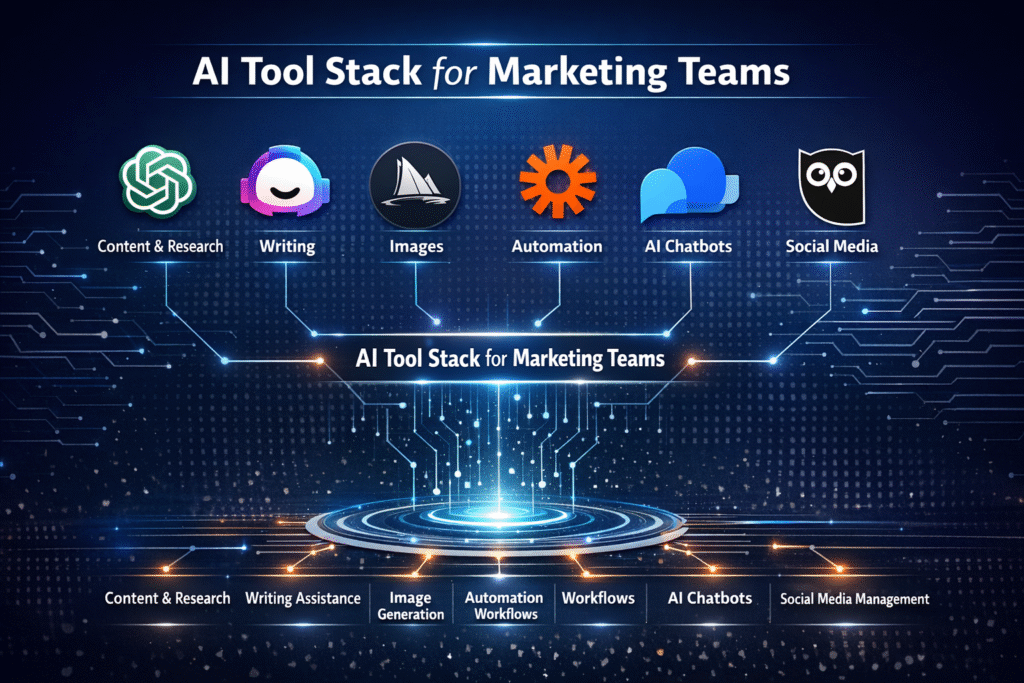
Several AI tools are available to help integrate artificial intelligence into marketing strategies:
- ChatGPT – AI Chatbot: This free (with premium options) AI-powered chatbot can answer nearly any text-based query. Its capabilities include brainstorming, outlining, conducting research, optimizing content, analyzing markets, and processing Excel files for predictive analytics, customer behavior forecasting, and competitive insights.
- Jasper – Content Generation: An intuitive platform designed for content generation at scale. It aids in optimizing content, conducting research, and generating various forms of marketing content. Jasper also features AI agents capable of autonomous operation. Pricing starts at $39/month/seat.
- Midjourney – Image Generation: An AI-powered image generation platform, accessible via Discord and a web app. Users provide text descriptions, reference images, and parameters to create realistic, animated, or surreal images for marketing. It is also exploring video generation. Paid plans start at $8/month.
- Hootsuite – Social Copy Generation: Beyond social media management, Hootsuite offers free AI-powered tools for generating social media captions, tweets, video titles/descriptions, hashtags, usernames, social media bios, and content/blog ideas. These tools serve as free valuable resources and promote Hootsuite itself. Social media management tools start at $99/user/month.
- Zapier – Marketing Automation: This AI-powered platform facilitates the creation of automated workflows (“zaps”) by connecting various tools. Examples include automatically adding leads to a CRM, new blog posts to a social media calendar, or new customers to a spreadsheet. It supports both basic and complex AI-driven automations. Free for up to 100 tasks/month, with paid plans starting at $19.99/month.
- Tidio – Chatbot: A chatbot software enabling businesses to create AI-powered chatbots for customer interaction. Tidio bots, trained with business information, can offer customer support, product suggestions, and appointment booking, while escalating unique or serious concerns to human agents. Pricing is flexible based on conversation volume, with a free tier for up to 50 conversations and paid plans starting at $24.17/month for 100 conversations.
FAQs
- What are some examples of AI in marketing today? Chatbots are a common example on business websites. Other applications include ad targeting, dynamic pricing, and tools like ChatGPT.
- How is AI changing the marketing industry? AI’s primary impact is the automation of repetitive tasks, allowing digital marketers to focus on larger-scale projects and higher-level strategy.
- How to use AI in digital marketing? Employ AI where it provides genuine value, such as automating tedious tasks (reporting, scheduling, customer service), accelerating content planning, and extracting insights from data faster. This allows human teams to prioritize strategy and creative work.
- Should you trust AI tools? AI tools are not inherently harmful. However, it is crucial to review all AI-generated content to prevent issues like plagiarism or factual inaccuracies.
AI Is the Future of Marketing
Artificial intelligence is a fundamental component of modern marketing. It can generate content, analyze results, predict trends, and much more. Businesses should explore the full range of AI tools to enhance their marketing efforts.